6 pm
Exhibition openings
Gianna Surangkanjanajai works primarily in sculpture, attending to situations in which form seems to surface from the conditions that surround it. Her works often take up geometric bodies, yet these figures appear less as fixed shapes than as points of departure, as structures that gradually soften, shift, or become porous through material change. Transparent volumes hold substances sensitive to light, temperature, and gravity; their appearance is never singular but unfolds in the rhythm of their surroundings. Sculpture here withdraws from the certainty of objecthood and appears instead as a process, an arrangement that keeps adjusting itself, remaining open to external conditions. At moments when the works operate at thresholds between material und immaterial presence, this openness gives rise to an expanded field of possibility.
Rey Akdogan turns her attention to the standardization of materials and perceptual processes that shape our visual present. Her often spatially oriented works unfold across media, moving between projection, sculpture, and installation. She examines how atmospheres come into being, and how color, light, and material qualities organize sensory experience and generate affective spaces. The materials she employs—color gels, printed plastics, fragments of packaging—originate in industrial and scenographic contexts and, in their customary settings, function to steer the gaze and regulate attention. In Akdogan’s arrangements, they slip out of these frameworks, rendering the operative logic of such systems newly tangible.
Opening in the garden hall
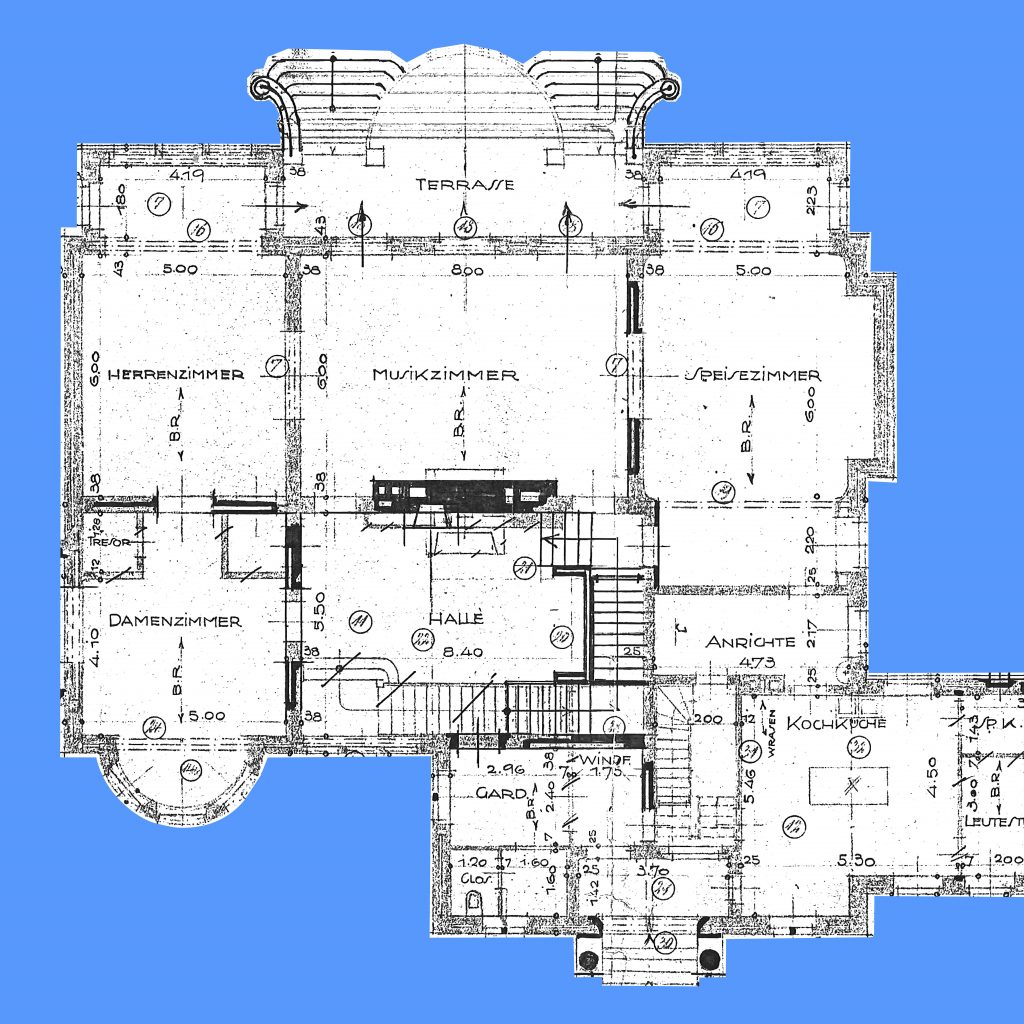
On the occasion of its 80th anniversary, the Haus directs its gaze back to its founding years – on the transformation from a private residence to an exhibition venue, on the ruptures and continuities of the post-war period, and on the traces these have left on the institution’s understanding of itself.
A display architecture developed by the Georgian curator and archivist Nina Akhvlediani (*1989 in Tblisi, lives and works in Tblisi) for the former garage (now the café) enables adaptable forms of presenting archival materials. In dialogue with contemporary artists, new perspectives on the house unfold, revealing that archives are always also a reflection of their very present.
Since… is divided into three chapters, the first of which is being developed by artist Luciano Pecoits.
Information about the exhibitions
As a friend and supporter, you can enjoy exclusive special events and free admission to all exhibitions. Support the museum’s programme with your sponsorship contribution and become a member.
7 pm
Exhibition openings
Gianna Surangkanjanajai works primarily in sculpture, attending to situations in which form seems to surface from the conditions that surround it. Her works often take up geometric bodies, yet these figures appear less as fixed shapes than as points of departure, as structures that gradually soften, shift, or become porous through material change. Transparent volumes hold substances sensitive to light, temperature, and gravity; their appearance is never singular but unfolds in the rhythm of their surroundings. Sculpture here withdraws from the certainty of objecthood and appears instead as a process, an arrangement that keeps adjusting itself, remaining open to external conditions. At moments when the works operate at thresholds between material und immaterial presence, this openness gives rise to an expanded field of possibility.
Rey Akdogan turns her attention to the standardization of materials and perceptual processes that shape our visual present. Her often spatially oriented works unfold across media, moving between projection, sculpture, and installation. She examines how atmospheres come into being, and how color, light, and material qualities organize sensory experience and generate affective spaces. The materials she employs—color gels, printed plastics, fragments of packaging—originate in industrial and scenographic contexts and, in their customary settings, function to steer the gaze and regulate attention. In Akdogan’s arrangements, they slip out of these frameworks, rendering the operative logic of such systems newly tangible.
Opening in the garden hall
On the occasion of its 80th anniversary, the Haus directs its gaze back to its founding years – on the transformation from a private residence to an exhibition venue, on the ruptures and continuities of the post-war period, and on the traces these have left on the institution’s understanding of itself.
A display architecture developed by the Georgian curator and archivist Nina Akhvlediani (*1989 in Tblisi, lives and works in Tblisi) for the former garage (now the café) enables adaptable forms of presenting archival materials. In dialogue with contemporary artists, new perspectives on the house unfold, revealing that archives are always also a reflection of their very present.
Since… is divided into three chapters, the first of which is being developed by artist Luciano Pecoits.